

A Look Behind the Curtains of ‘The Other Halfʼ
Contributing Writer Harman Aujla ʼ28 offers a behind-the-scenes overview of the creative process behind the production of “The Other Half” a play written by Miles Garcia ʼ26. She describes the playʼs emotionally wrought plot, and reflects on her and others' experience acting in the play.
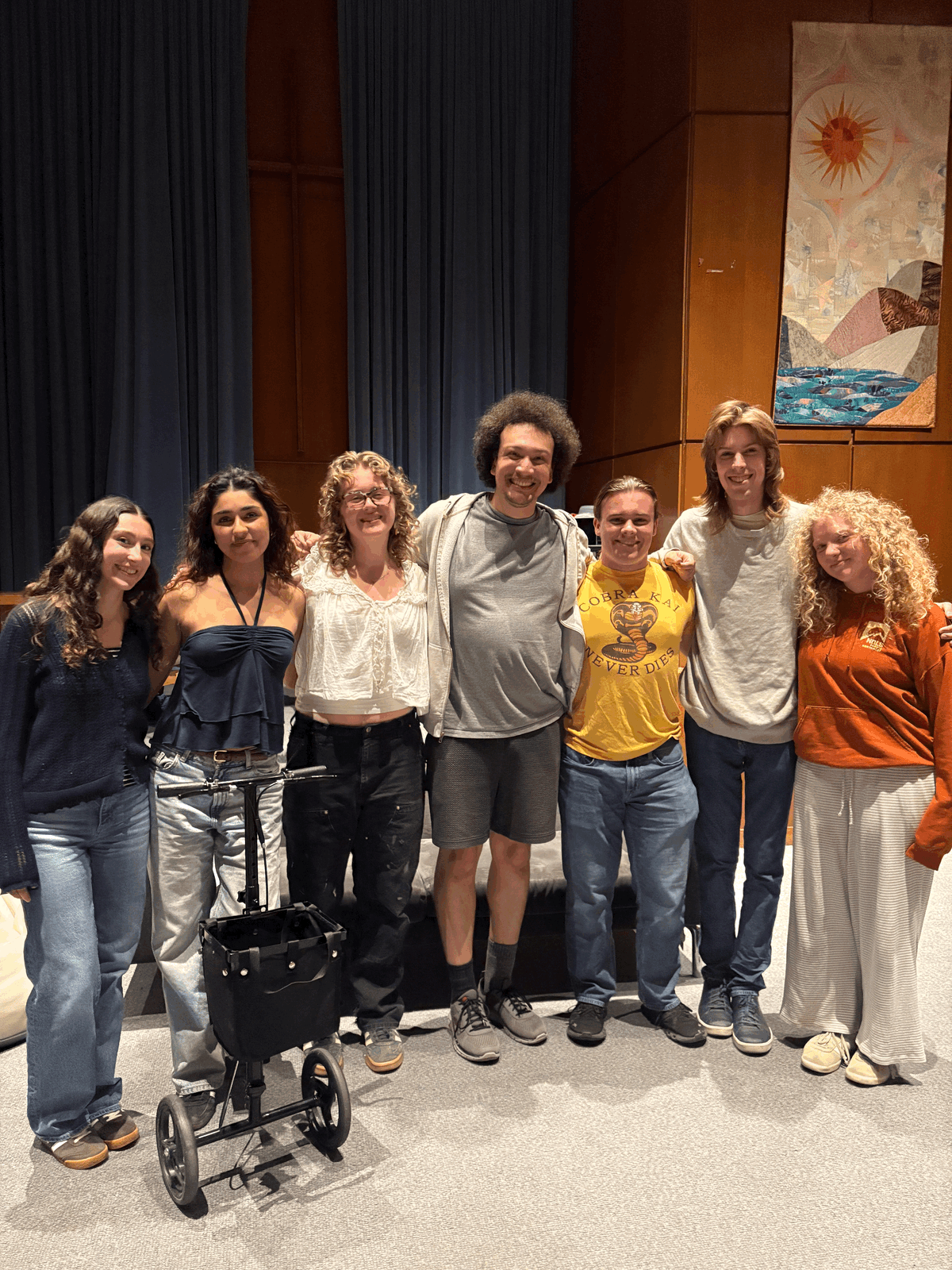
Last semester, seven students came together to put on a production of a play written by Miles Garcia ʼ26 titled “The Other Half.” The play opens with Stephen appearing at his ex-girlfriend Samantha’s dorm after not having seen her for the past year. Then the audience learns that Stephen’s mental health issues drew a rift within their relationship, a tension that underpins the rest of the play.
This emotionally vulnerable and honest exchange is abruptly interrupted by Samantha’s sister, Les, who brings the unfortunate news of their mother overdosing. The play deals with heavy themes of family trauma and mental health issues while weaving humorous lines through the character of Ryan, Samantha’s roommate and an audience favorite. Ryan’s jokes and candid remarks lift the tension of the heavy conversations and provide brilliant comic relief. Throughout the play’s two-hour duration, the audience is thrown into chaos. Characters’ lines feel like punches to the gut, and moments of tension and awkwardness build up until the characters explode and their raw thoughts come out in long monologues. These streams of consciousness are blunt and lay a character’s true thoughts bare. The play is an intense meditation on how family and mental health trauma can bleed into relationships and social interactions.
In a post-play interview, Garcia described the process of writing the play as a “long process of trial and error that also felt therapeutic to write because it was maybe concurrent with the trial and error of working through some problems I was going through at the time.” Garcia’s process of writing was experimental, as was the directing and acting process in this play.
The casting directors took the liberty of taking a chance on people with limited acting experience, such as Emma Burd ’26 and myself. The play was directed by Riley Donat ’28, who was also experimenting as a first-time director. When everyone came together at the read-through and rehearsals, each with their own perspective on the play, Donat took on the difficult task of bridging a plethora of different perspectives with her own vision as the director to ultimately drive the creative process forward. Despite it being Donat’s first time directing, she succeeded in leading everyone through rehearsals and in shaping words on a page into an engaging story by finding the middle ground between different visions in the room. This surrender of control was echoed by Garcia, who said he was forced to “relinquish [his] white-knuckled hand.” As the writer, Garcia had a vision for how he wanted the performance to look and sound but had to forgo this and “let the actors own the words instead.” The artistic process was shaped and transformed by an amalgamation of different perspectives that made the entire process feel dynamic and alive.
Burd auditioned in her last semester of college as part of her “say ‘yes’ semester to push [herself] outside of her comfort zone.” In a recent text message, Burd expressed that “every day was a challenge, from trying to memorize a ton of lines (half of which were ‘uh’ and ‘um,’ which somehow made them even harder to remember) to learning how to plant my feet during scenes.” At Amherst, it is common to see people engaging in extracurriculars they are already proficient in and have spent countless hours honing in high school. The participants of this play instead embraced experimentation and stepped away from the Amherst norm of engaging in avocations they had started at age 12 to see what lay in the unknowns of the world of theater. Burd, Donat, and I were particularly surprised by how theater could facilitate community, with Burd stating that “the play brought [her] closer to the rest of the talented and kind cast, which was particularly special to [her] to close the chapter at the end of my four years of college.” The play became more than something we had to memorize lines for and was a unique opportunity to experiment for the sake of creativity, storytelling, community, and self-exploration.
As for myself, I had auditioned spontaneously, as I wanted to try something new. Fortunately, the play came at a time when I was dealing with a serious personal injury, and instead of focusing on the difficulties of getting around campus with a broken ankle, my attention was diverted toward getting into the character of the strong older sister, Les. Now that I have recovered from the injury and the play is several months in the past, I write this piece because I look back on that medically intense part of my life and am extremely grateful for the solace that this experience provided and remain surprised at how different the experience was from my expectations.
This sense of connection extended beyond rehearsals and into the wider Amherst community when peers trickled into Chapin Chapel on Friday and Sunday evenings. Garcia, having written and directed plays before, notably remarks that he considers his productions to be “an invitation for our friends and peers to come and play a game with us for an hour or two too.”
For the two hours that the play went on, the audience shared laughter, gasps, shock, and silences where it felt like the room was holding their breath. In a post-show text message, Annie Dai ’28, a member of the audience, stated that “it felt really special to see my friend up on stage and look around the audience and recognize so many familiar faces.” Stepping away from books and problem sets to come together and explore a passion for storytelling transformed the chapel into a third space for community and creativity built on experimentation.
“The Other Half” left a positive and lasting impression on its members and audience. Being in this play as someone who had not acted before and running lines with friends outside the play served as a reminder that theater is for anyone and everyone.

Comments ()