

Class of 1979 Alumnae Reflect on Coeducation
On Friday, seven women from the Class of 1979 visited campus for a fishbowl conversation on 50 years of coeducation. The alumnae described the hardships they faced connecting with peers, gender barriers, diversity, feminism, and opportunities at the college.
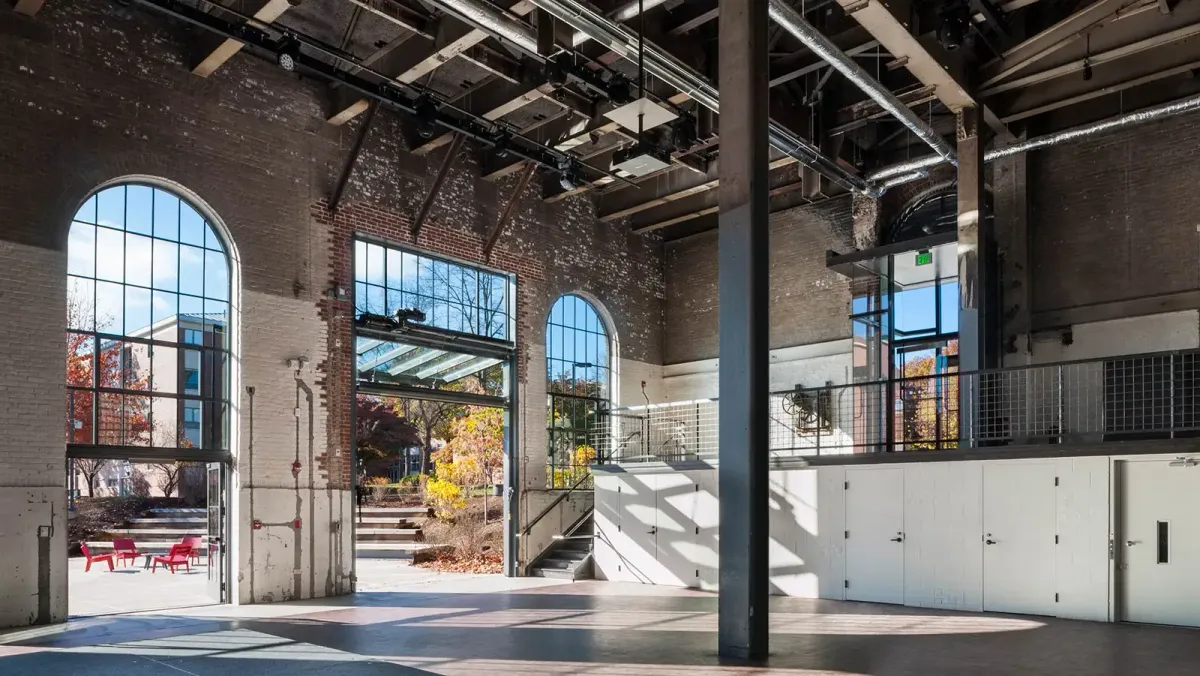
On Friday, seven women from the Class of 1979 participated in a fishbowl conversation reflecting on 50 years of coeducation at Amherst. The conversation was part of “Pioneers, Professors, and Pupils: Gender Across Eras,” a symposium commemorating the 50th anniversary of coeducation at Amherst, co-sponsored by the Office of Diversity, Equity, and Inclusion and the Department of Sexuality, Women’s, and Gender Studies. Held in the Eighmy Powerhouse, the symposium also featured faculty and student panels.
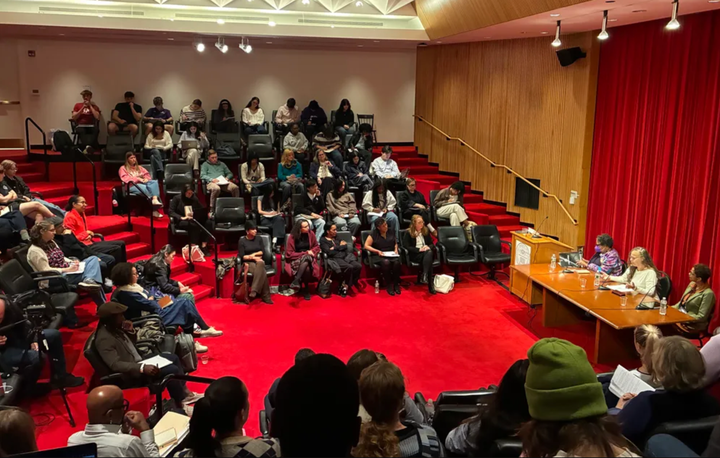
The alumnae discussion centered on the premise that there is “another kind of history” beyond “dates and milestones and institutional records.” Director of the Center for Restorative Practices Suzanne Belleci moderated the conversation, describing it as “a restorative circle […] held in the presence of witnesses.” She emphasised that it was neither “a panel [n]or a Q&A.” Over the course of an hour, the seven speakers were posed six questions that members of the Amherst community submitted in advance.
Before the conversation, Vice President for Equity and Inclusion Pawan Dhingra and President Michael Elliott delivered brief speeches. Dhingra spoke about how the story of “coeducation [...] can influence what we study, how we teach, [and] how we understand both the arts and sciences.” Elliott called the anniversary “a moment for us to reflect as a campus about where we are, where we’ve been, and where we’re going.”
Elliott referenced The Amherst Student’s Oct. 21 editorial that reflected on coeducation at Amherst, which he described as a “very thoughtful set of reflections.” Today, he said, “coeducation feels almost inevitable,” but “where we are now is not inevitable.” Elliott emphasized that “it took the work of many, many female students and faculty to build the organizations, the structures, the clubs, the teams, that have enabled women to thrive at Amherst over these decades.” Echoing a theme that recurred throughout the discussion, Elliott added that “that is not to say the work is complete now.”
The session opened with introductions of the seven speakers: Claudia Brown, Rose DeClue, Wendy Gardner, Mindy Pickard, Nancy Shepard, Jill Still, and Randi Zeller. Returning to Amherst to commemorate the anniversary brought up a range of emotions. Brown reflected that “what had been an uncomfortable feeling about [her] college, and [her] experience in college, and the college itself, has transformed into a very positive one.” Others described feeling “happy,” “privileged,” “emotional,” “amazed,” “filled with wonder,” “curious,” “proud,” and “overwhelmed.”
The seven women had transferred to Amherst from six different institutions, each for her own reasons. Gardner, who transferred to Amherst from Cornell University, connected her experience with recent concerns about women’s safety following the ongoing rape investigation at Cornell. “You can’t mention Cornell today without a siren going off to remind us that we still have work to do for women,” she said. “I think it’s important to continue to remember that.”
Their experiences of arriving at Amherst varied just as widely. Shepard “remember[ed] feeling just excited to jump in,” while DeClue recalled that she “had never been so terrified in [her] life.” Gardner said her “first year was truly wonderful,” but that experience “did start to change.” The women described the familiar challenge of finding one’s community as a young adult, but also spoke of the unusual experience of being a woman “in a sea of men.” Pickard explained that her male peers “tended to tease us [women] a lot, as if [...] the girls at Smith [College] and [Mount] Holyoke [College] were different than the girls here” at Amherst.
The women remembered feeling that they did not belong or were not welcome, many criticizing the administration’s handling of their transition to Amherst, particularly its failure to create support systems for the incoming women. Still described “a lack of supportive programs for [the women],” and DeClue said they “sorely needed some type of orientation, mentorship, [and] weekly meetings.” Zeller recalled that the lack of “effort to connect us was isolating and challenging.” Gardner characterized the administration’s shortcomings as “an unforced error.”
The alumnae also described how difficult it was to find and connect with their female peers. “It wasn’t until graduation, looking out, that you realized there were women in the class,” DeClue said. “I remember thinking, ‘where were you all?’”
Some alumnae, however, attributed their isolation to factors in addition to gender. Zeller said that coming from “a not very well off family” compounded her difficulties: “It was both gender, but it was also socioeconomic.” DeClue also acknowledged the inherent challenges in transferring to a new college, noting that “it’s difficult to transfer into an institution, even if it was all women.”
Others pointed more directly to the gender barriers they encountered, including “the lack of women’s bathrooms” and male peers telling them to “not walk so loud.” Still recalled feeling “intimidated” in classrooms dominated by men. Brown described getting “flak” for participating in the Amherst Women’s Group, an early iteration of the Women’s and Gender Center, including receiving “hate mail” and finding that “somebody broke into [...] and trashed” the center.
For Shepard, “the negative [...] was that [she] loved Amherst so much [...], but at the time, maybe [Amherst] didn’t love [her] back.” Regardless, she said “Amherst almost embodies” her and how she lives her life.
Nevertheless, the alumnae spoke fondly of the opportunities Amherst offered. Pickard recalled taking her “first film class here with a wonderful teacher, and it completely opened [her] eyes.” Brown described how she “thrived” in the American studies program and reminisced about her “great teachers.” Others highlighted the dance program, the Department of European Studies, a psychology professor, and the ways Amherst had “expanded [their] world in a million ways.”
Gardner described recently wondering whether she would have been happier had she gone to a different liberal arts college that wasn’t going through the coeducation process. Ultimately, she concluded that she would not have been happier elsewhere.
The alumnae also stressed the importance of diversity and feminism. Brown said that feminism “is good for humans,” not just women. Similarly, Gardner characterized coeducation at Amherst as “a collective experience of moving education forward, for women, and actually for men, too.” The speakers emphasized the need to include all minority groups and praised the “good work” of the Office of Diversity, Equity, and Inclusion.
As the conversation drew to a close, the seven women reflected on what they will take away from this experience: friendship. Garner and DeClue shared that most of them had “met [...] for the first time at [their] 45th reunion,” and had since become “a wonderful group of new friends.” Although they were grateful to be “taking away six very close friends,” they also pointed out something troubling about the fact they had not formed these connections while at Amherst.
Prior to participating in this circle, Zeller “had no idea that the other women felt the same way [she] did.” Learning that they had shared similar experiences at Amherst gave her “more sympathy” for her younger self. Zeller, who had “never felt part of the Amherst community” until then, felt this discussion and process “ha[ve] given [her] Amherst.”
Audience member Francesca Purcell ’89 said she was “heartbroken that they actually didn’t develop these friendships with one another until just a few years ago.” She also described the conversation as “really moving to hear everybody’s voices.” Kazu Domae ’28, a transfer student from Japan, expressed similar emotions, voicing her appreciation for the alumnae and the “positive impact” they have had on Amherst.
Raine Kamilova ’28, who participated in the student panel later that day, said the discussion “gave [them] a lot to think about.” They described Amherst as “one of the few places that has felt like home to [them],” making it especially jarring to hear “that was not [the alumnae’s] experience.” They were struck “that [the alumnae] felt like they had to conform” and that Amherst was “unsafe and isolating” for them. “I’m shocked to see how far we’ve come in 50 years,” Kamilova said.

Comments ()