

Editorial: The Amherst We Inherited
Marking 50 years of coeducation, the Editorial Board reflects on the long and contested road the college took on admitting women. The Board argues coeducation’s ordinariness is Amherst’s triumph, but that mistaking what is normal for what is permanent grants us permission to stop progressing.
It has been 50 years since Amherst College became coed. For us, The Student, this anniversary carries a peculiar significance. When the decision became public, we ran what is arguably the biggest headline in our history: “WE’RE CO-ED!” In archival footage of the trustees’ decision becoming public, the camera pans to a student holding the issue up at a football game. Fifty years later, when we look back at this moment in Amherst’s history, we are also looking back at our own — even if it feels like a completely different institution.
It is difficult, from the Amherst of 2026, to comprehend just how different the Amherst of 1974 was. Today, coeducation feels so utterly unremarkable that the most remarkable thing about it to us may be how little we think about it.c
That, in some sense, is its greatest achievement.
But the ease with which coeducation can feel like a given today can obscure how contested it was and how embarrassingly long Amherst took to get there. Arguments over admitting women stretch back well over a century before Amherst actually did so. In 1870, The Student published an editorial claiming that admitting women would be impractical and costly because “everything [at Amherst] is calculated for men.” The Trustees considered and rejected coeducation in 1871. More than a century later, the question remained unresolved: After President John William Ward recommended coeducation in 1972, the Board of Trustees initially declined to make a decision, prompting students to organize the Organization for Coeducation at Amherst Now in protest. Only in 1974 did the Trustees finally consider voting to admit women as degree candidates, and it was still unclear how the decision would turn out.
That history complicates the celebratory language that the administration touts of a 50th anniversary. Fifty years of coeducation is absolutely worth celebrating, but becoming coeducational in the mid-1970s is not, by itself, evidence that Amherst was exceptionally progressive. In fact, Amherst’s turn towards coeducation was part of a broader wave: Yale University and Williams College, for instance, went coed around the same time (1969 and 1971, respectively). Nearby, the University of Massachusetts Amherst had already been enrolling women since 1875, while Cornell University had committed to coeducation since 1872. If anything, the anniversary asks us to reckon with an institution that had spent generations debating whether half the population could belong here.
Coeducation was never a night-and-day change. Women have been part of the college even before it fully recognized female students as members of the college. Amherst’s first female faculty member was Madeleine Bôcher Utter, a French instructor hired in 1918 to fill a teaching vacancy during World War I. The next was visiting professor Dorothy Wrinch in 1941, followed by Rose Olver in 1962, who became the college’s first tenure-track female professor and remained its sole woman on the faculty for four years. Women participating through exchange programs were already studying on campus before the first entering Amherst class that included women arrived. Nine women participating in the 12-College Exchange transferred into Amherst and graduated with the Class of 1976. The supposedly all-male Amherst was never quite as neatly male as its institutional identity suggested.
Changing who was allowed through the gates was only the beginning of changing what kind of institution existed behind them. The college’s adoption of coeducation did not automatically produce an institution equitable or accommodating to women. We need to resist the telling of the history of coeducation as a tidy success story: Once upon a time Amherst excluded women, administrators eventually saw the light, women arrived, and progress marched happily onward.
Unfortunately, that is not how institutional change works. It happens because people make demands that institutions initially regard as inconvenient, unnecessary, radical, or premature. The archival record of coeducation is filled with debate among students, faculty, alumni, administrators, and Trustees over what they thought Amherst should become. The college’s own archival coeducation collection preserves decades of responses and arguments over the change. What now seems inevitable was once anything but.
There is something humbling in that fact. The Amherst students of 1974 did not know how the story would end. They did not know that, 50 years later, students would walk around a coeducational Amherst without thinking twice about it. They were arguing about what Amherst could be while living in an Amherst that was not yet that place.
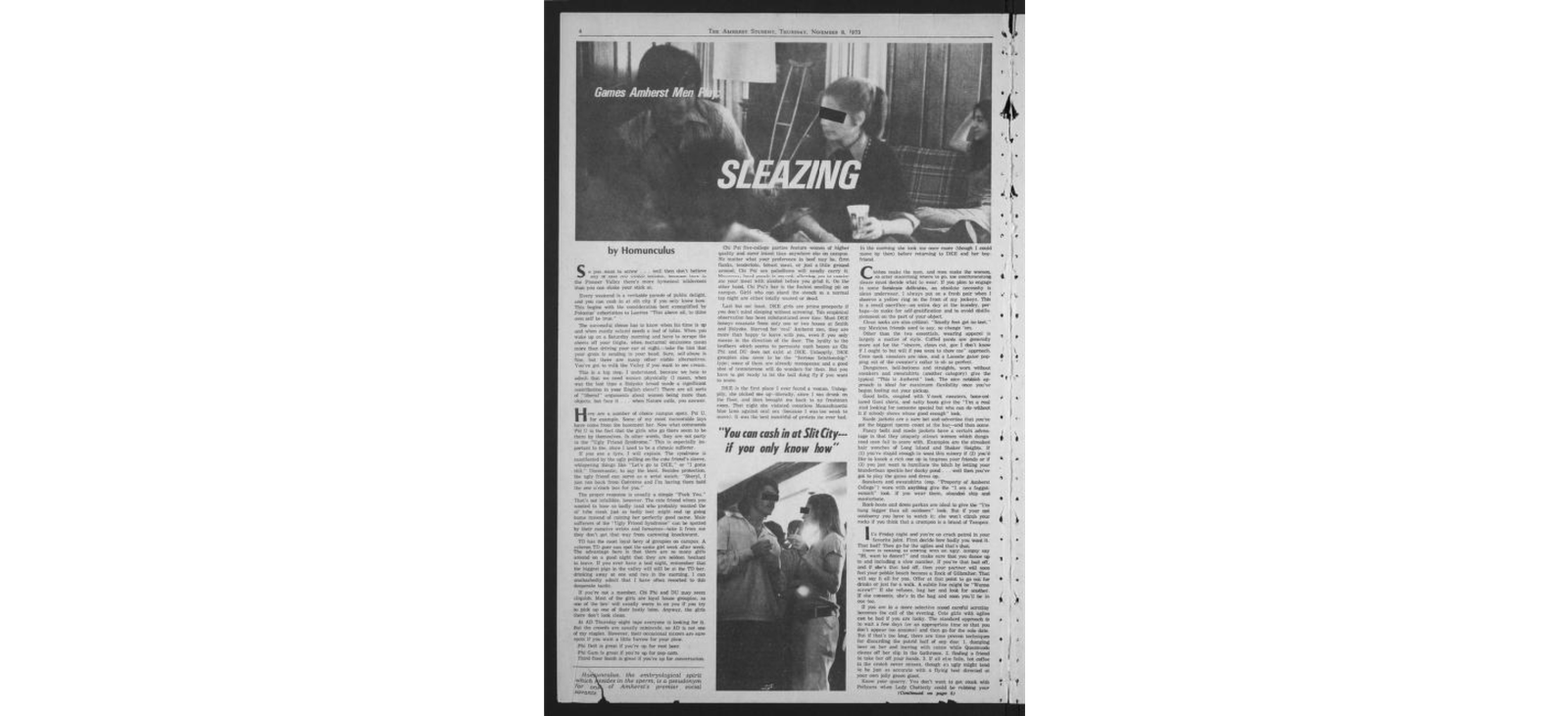
We should extend particular gratitude to the women who entered that uncertainty. The first female students at Amherst did not receive just the benefits of institutional progress. They had to live through awkward, incomplete, and sometimes hostile implementation. Olver remembered people saying “the presence of women would … tame the savage beasts in [the] dining hall, dorms, fraternities.” An article entitled “Sleazing” appeared in The Student in 1973, basically telling male students how to have casual sex with local college women without commitment. “We hate to admit that we need women physically (I mean, when was the last time a [Mount] Holyoke [College] broad made a significant contribution in your English class?)” the article read. “There are all sorts of ‘liberal’ arguments about women being more than objects, but face it … when Nature calls, you answer.” A 1984 Amherst College report on faculty women found more women faculty left than stayed, finding that women viewed the “bootcamp-like” male teaching styles as abrasive and aggressive, and that younger women who taught differently received poor evaluations.
Female faculty continued to report discrimination and felt uncomfortable in Amherst’s male-dominated environment, to the point where Amherst had the lowest percentage of female faculty among the 12-College Exchange. They entered a college whose traditions, social structures, physical spaces, alumni culture, and very conception of itself had been built around men. But their presence and persistence helped transform what an “Amherst man,” or now an “Amherst student,” could mean.
That transformation is visible in our own newsroom. Today, women constitute most of the staff responsible for reporting, editing, photographing, designing, and producing this newspaper. There is no triumphant headline announcing that fact because there does not need to be one. It is ordinary. And there is something genuinely beautiful about that ordinariness.
Perhaps that is why an anniversary celebrating coeducation can feel strangely distant to current students. There is a temptation to scold students for not attending enough anniversary events or exhibiting the appropriate amount of historical enthusiasm. We are less interested in doing that. What exactly should a student born decades after coeducation feel when told to commemorate it? Most of us cannot imagine Amherst without women because that Amherst bears so little resemblance to the institution we inhabit. The distance that many students hold is not necessarily apathy, but evidence of cultural transformation.
But taking something as a sort of given carries another danger: We can begin to mistake what is normal for what is permanent. Amherst today is profoundly different from the Amherst that debated coeducation, not only through the admission of women, but through generations of conflicts over who belongs here, who gets heard here, and what obligations the college has to its students. Those changes should make us proud. They should also make us challenge the idea that Amherst’s current form represents some natural endpoint of progress.
Institutions do not become just once. We still inherit pieces of the overwhelmingly male past today, sometimes obviously and sometimes so routinely that we stop noticing them. Amherst has spent decades wrestling with traditions and institutions inherited from earlier versions of itself, from the Lord Jeffs to fraternities, and other social structures that formally disappeared but never vanished completely from student culture. Even something as simple as the limited women’s restrooms in older buildings like Chapin Hall reminds us of a time where they were the minority on campus. Coeducation therefore belongs to a larger question Amherst has never stopped facing: What do we owe the institution we inherited, and what are we willing to leave behind?
Fifty years from now, students will inherit our Amherst. Some injustice or exclusion that seems entrenched to us may appear bafflingly obvious to them. They may read through old issues of this newspaper and wonder why we argued for so long about something they regard as common sense. We hope they do.
Our responsibility, then, is to make sure Amherst does not again wait until everyone else has changed before finding the courage to change. The lesson of coeducation should not be that Amherst eventually gets things right. “Eventually” is not good enough. We should want an Amherst willing to move before justice becomes unavoidable, willing to listen before students have spent years demanding to be heard, and willing to question traditions before their failures become obvious in retrospect. The college should aspire not just to catch up with history, but to get ahead of it.
Unsigned editorials represent the views of the majority of the Editorial Board (assenting: 9; dissenting: 0; abstaining: 0)



Comments ()