

Editorial: We Still Don’t Have a Newsroom
The Editorial Board confronts the college’s continued failure to provide The Student with a functional newsroom, arguing that temporary fixes cannot replace the permanent home a newspaper needs to thrive.
Dear readers,
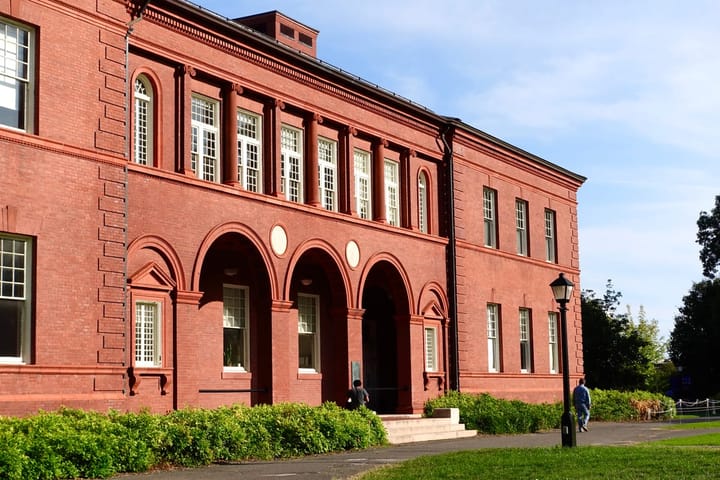
Thank you to everyone who has asked for an update on our newsroom in the Ford Student Center (Ford). Unfortunately, there is not much of an update to give. The short version is this: We still do not have a functional newsroom.
The space at Ford that the college promised us remains unusable due to the constraints we have already outlined. On Tuesday nights, when we produce the paper, we work out of the Barker Room on the A-Level of the Frost Library until the end of the semester through an agreement with the library. While we are deeply grateful to the library for giving us a temporary home, we are aware that a temporary room we obtained ourselves is not a newsroom.
This may be the first semester in decades, if not in The Student’s history, that the paper has operated without a newsroom. We have previously operated out of the basement in Morris Pratt Hall, the second floor of Keefe Campus Center (where the Queer Resource Center was), and, most recently, occupied Morrow Dormitory’s basement from 2016 until last semester. Morrow was far from perfect, but it was ours, and it worked. We had space for the traditions that made the newsroom feel like a home rather than just an office: the snack-et (where we rank snacks every semester in sports bracket style), our quote wall (a record of the most heated conversations of each production night), old issues of the paper dating back to the 1990s, and all the miscellaneous evidence of generations of editors who had occupied the space before us (including a Shakespeare cutout and several books on sexuality in medieval literature). In our temporary space, we cannot permanently store and access equipment or memorabilia. And even if our newsroom in Ford — colloquially dubbed “the red room” — were usable, it would never be entirely our own, as we became recently aware that the college plans for the space to be shared with other student organizations.
The college has effectively rendered our podcast section inactive, as we have been struggling to find an appropriate recording and production space. We also lost access to our archives, equipment, past issues, and other materials that a newspaper naturally accumulates and need to be accessible to our editors, as the room almost always remains locked. The office of Student Engagement and Leadership keeps the one master key, so accessing the space requires asking for permission when the office is staffed (from 9 a.m. to 5 p.m.). Ford’s 11 p.m. closure — hours earlier than the 1 a.m. closure we were initially promised — only exacerbates this issue, since we often edit long past midnight. It should go without saying that a newsroom is not particularly useful if the newspaper cannot reliably access or inhabit it.
Granted, our actual needs for publishing the paper are fairly simple. We need computers that can run InDesign, storage for past issues and equipment, enough room for editors to work together on production nights, and space to record for our podcast section. We have imagined a few possible options, one (and probably the most practical) of which is to move back into our former newsroom in Morrow if allowed. Another is to relocate to one of the nondescript study rooms somewhere else in Ford that could better accommodate our staff — after all, we only need it for one night per week. If renovation is possible, the college could remove the wall separating our current newsroom from the adjacent storage room, though even that may not give us enough space. Another possibility would be expanding into the neighboring WAMH lounge, whose members were gracious enough to let us use their space the one night we attempted to hold production in the red room. None of these options are ideal.
As stated previously, the Barker Room has sustained the paper through a time of deep uncertainty, and we remain grateful to the library for making it available to us. But it is not our newsroom. Our computers are not there. Our archives are not there. Our equipment is not there. When an editor needs to look through old issues for reference, those materials are not sitting on a shelf beside us as they once were. When we need a break from staring at screens, the quote wall that holds many fond memories is no longer around. We have been given temporary fixes that have allowed us to continue publishing. What we have not been given is the permanent, functional space necessary to operate the newspaper as we are supposed to. What the college continues to withhold from us is a true home.
At this point, it is becoming increasingly difficult to believe that the administration considers our newsroom a priority. We have raised these problems; we have continued producing the paper despite them, and yet we still do not have a functional space. The Student has the staff, ideas, and ambition to do good work. What we lack is the basic infrastructure the college promised us.
We have improvised solutions because we have had no other choice. But our ability to work around the college’s failure to provide us with a functional newsroom should not be mistaken for evidence that the current arrangement works. It does not. We have proposed alternatives and figured out workarounds because we are committed to ensuring the newspaper comes out every week, because we believe that the broader community benefits from our participation in it. We continue to welcome conversations and suggestions about finding a suitable home for us.
Our contribution is also dependent on how the community interacts with us. This editorial, for instance, would not exist if someone in our community had not reached out and asked us for an update. So, we want to make that invitation explicit: email us. Ask us questions. Ask for updates on articles. If you are wondering what is going on with The Student, there is a good chance someone else is wondering the same thing. The best ways to reach us are by email at astudent@amherst.edu and on Instagram at @theamherststudent. We will respond.
Sincerely,
The Editorial Board
Unsigned editorials represent the views of the majority of the Editorial Board (assenting: 19; dissenting: 0; abstaining: 1)
Comments ()