

Willow Delp: Caring as a Method
Willow Delp’s life at Amherst is defined by care and activism — through their column “Anti-Ableist Amherst,” their research on racial injustice, and their efforts dedicated to establishing safe spaces across campus.
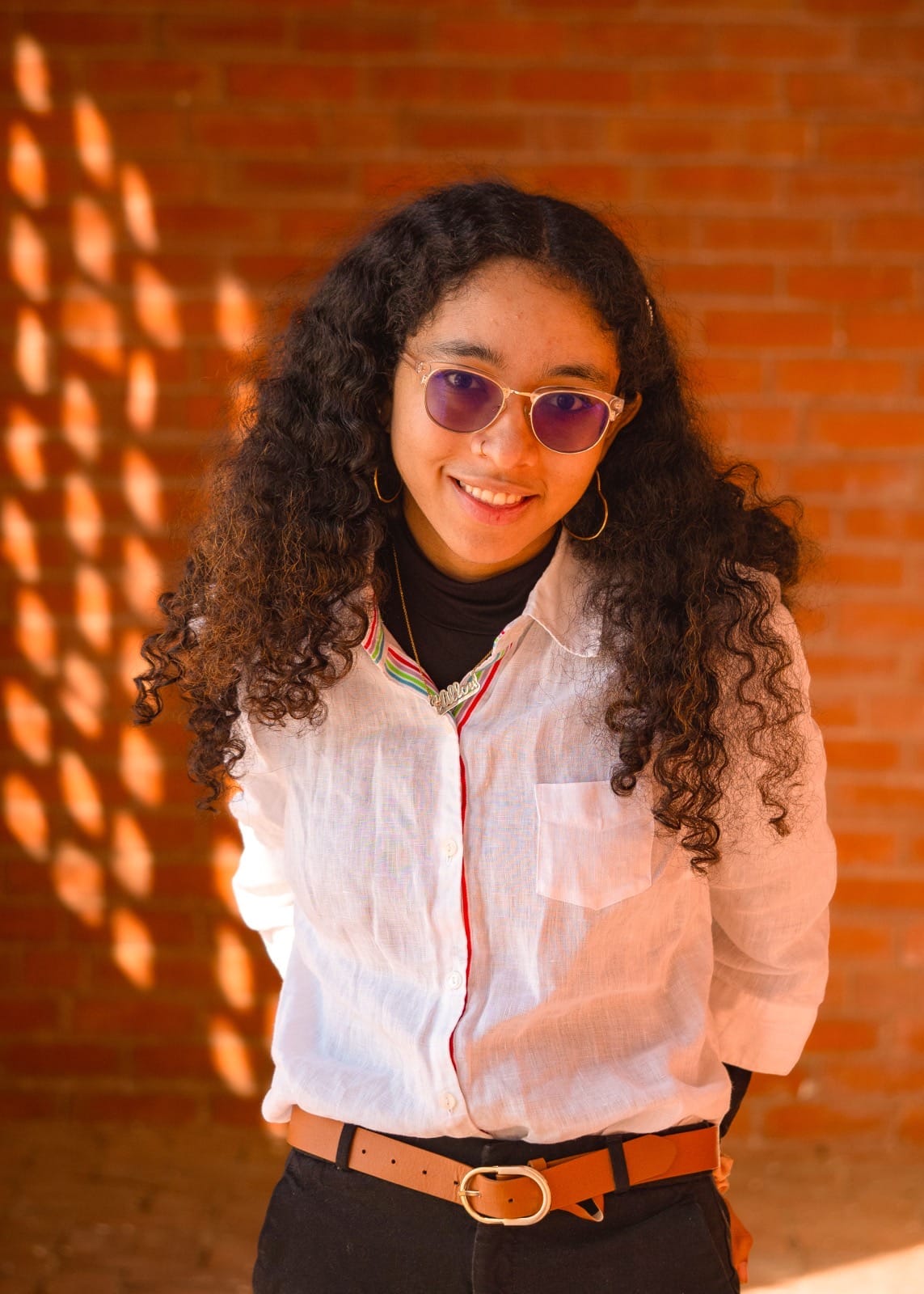
Willow Delp ’27 cares a lot. About everything. And everyone.
I was so excited to interview Willow (sorry — I’ll make this about me for just a second) as they might be one of my favorite people on this campus. I don’t think I could ever find the words to fully do Willow justice, so just know they are even more remarkable and extraordinary than what I’ve written here.
Willow is the kind of person you should know. It shows up in how they write, how they listen, how they advocate, and how they move through Amherst with an eye toward who might be left out. Their friend Aaron Bai ’28 told me “they’re very, very emotionally observable. [T]hey know how to hold space … [and] … check in properly; [they are] so emotionally aware ... that’s a much tougher skill than it seems like on the surface.”
They’re also from New Jersey (like me) which is worth mentioning if only because we both remain steadfast in our belief that New Jersey is, undeniably, the best place on earth and because we both agree that New Jersey-phobia remains a serious and under-discussed issue on this campus.
All jokes aside, Willow is someone people believe in. Every person I spoke to about them said some version of the same thing: that Willow leaves a mark, that they make spaces gentler and more thoughtful simply by being part of them, that Amherst feels different because Willow was here. No one summed it up better than their friend Alfie Cooper ’26 did: “Willow moves with this belief, and moves others with this belief, that anything is possible — that things are always going to be difficult, but that there’s always going to be good in this world, and ways we can fight for it. I feel like no one has a keener eye for being in this world, and every single conversation I’ve had with them — of which there have been countless — I feel like I walk away changed, genuinely.”
Willow will go far in life — not just because of their achievements, of which there are many — but because of their character. They care deeply, they act on that care, and they invite others to do the same. And in a place like Amherst, that presence matters more than we often realize. We will be losing a truly incredible person at Amherst, but it is due time that they go out into the world.
Writing, Seeing, Naming
Much of Willow’s impact at Amherst can be traced through their writing. Before I held the position, Willow served as a managing opinion editor for The Amherst Student — a role they understood as an opportunity to shape what the campus was willing to talk about, and how those conversations unfolded. Most notably, Willow created and wrote many editions of “Anti‑Ableist Amherst,” a column that emerged from a gap they could not ignore. “Various disabling missions in my life have impacted me, influenced the way I see the world,” they said. “I disabled such a neurodivergent identity around that time, around that time period, and I saw this lacuna in terms of what’s being addressed on campus.”
Willow had noticed that while conversations around identity and marginalization existed on campus, disability — in all its forms — was often absent, or treated through a narrow and paternalistic lens. From the beginning, Willow’s writing resisted that framing. Writing about disability was about articulating an entire way of moving through the world. As Willow put it, “ableism and neurodivergence … really color the way I see the world,” shaping not only campus buildings, but relationships, habits, and social life itself.
Willow’s earliest writing for The Student examined Amherst’s physical inaccessibility and the rhetoric surrounding disability on campus. As they came more fully into their disabled and neurodivergent identity, their writing deepened alongside it. When talking to me about their writing, they emphasized the importance of disabled people shaping their own narratives and producing their own research, instead of others to dominate the conversation.
Moreover, they made sure that all voices were heard, particularly those that are too often overlooked or unheard. They interviewed disabled and neurodivergent students, often centering voices that rarely make it into official or institutional narratives. At its core, everything Willow wrote was grounded in this idea: “I want to be an advocate for you. And so just someone … who can kind of absorb that, those things, or other people,” as they put it.
The response to “Anti-Ableist Amherst” was immediate and deeply personal. People recognized Willow in Valentine Dining Hall, at parties, and in the stacks at Frost Library — stopping to say that Willow’s writing finally put language to an experience they couldn’t name before. They told me that is part of what The Student does at its best — long after a semester ends, the words remain. Just as they looked up articles, someone will look at theirs and read them years later. And in those many years later, someone will feel less alone because they exist at all. As Willow reflected, “I [hope] with activism, the future disabled and neurodivergent students at Amherst [will] be more okay with themselves.”
In a place that often prides itself on progressiveness while falling short in practice, Willow used writing to see what others overlooked — and named it, so that the rest of campus would have to see it too. Willow loves Amherst — no doubt about it — and their critiques always came from a place of love: love for the people who deserved better and for an institution they believed was capable of more.
Making Community
A throughline connecting Willow’s character and their writing is community — and boy, do they do that. If Willow has a signature way of moving through Amherst, it is through the careful, consistent creation of spaces where people feel allowed to exist as they are. Simply as people. That impulse — to make room, to respond with care, to meet people where they are — has shaped Willow’s involvement across Amherst. From the Disabled and Neurodivergent Alliance (DNA) to Queer and Trans People of Color spaces, the Multicultural Resource Center, the Mellon Mays Undergraduate Fellowship, and many other communities, Willow gravitated toward spaces that differ in form but share a commitment to mutual care and collective growth.
For Willow, community is, as they described it, the work that often begins with listening. “I’ve been able to really connect with members of the community,” they said when discussing a recent DNA meeting. “A lot of my most recent meetings [with people] were just like, ‘let’s just have a space for you to … just exist as people who are not going to judge each other, not going to stigmatize each other.’”
Willow emphasized the importance of asking difficult but practical questions together: How do we adapt to campus life? How do we make ourselves more comfortable in an environment that is often very uncomfortable? How do we meet our access needs, etc, and just being [as] receptive as possible to that? Disability activism, for Willow, is not confined to a single organization or initiative. “I just kind of see disability activism [as] something I try to tackle multiple fronts,” they said.
When I asked what they had cared about most during their time at Amherst, Willow returned to optimism — not naive hope, but a belief that understanding can be built. “Disability optimism, most of all, [is] something I’ve cared about a lot,” they said. That optimism is rooted in education and empathy. “Compassion is visible, but also understanding is important to bring,” Willow said. “So people can understand what the differences are that people may have in sensory differences, in physical differences, etc.” For Willow, this process is incremental but powerful. “You can start from that point of not [knowing] to knowing, to understanding, to appreciating.” That movement — from ignorance to care — is at the heart of how they envision change.
Community-building is inseparable from advocacy, even when advocacy comes at a personal cost. “I hope I would leave a legacy of care and … kindness, also advocacy and speaking out for what’s right,” they reflected. That commitment has never been easy. “I try to … have something I believe in, even when there are social costs,” they said. Willow spoke candidly about the fear that accompanies visibility — wondering whether people will be upset, whether speaking out will make things harder. Still, their guiding principle remains clear. “Sometimes the right thing is hard to do,” they said. Rather than avoiding discomfort, Willow has learned to sit with it. “You kind of just do it and think, ‘am I willing to bear the cost?’” And sometimes I want to bear the cost … At least some of the time, I think it’s more valuable to me to do this thing that is difficult … than to just keep moving like everything is normal.”
“Make things a little uncomfortable sometimes,” Willow added, “because, you know, people need discomfort to grow.”
Researching and Doing Justice
The reason I know Willow at all is through various advocacy efforts across campus. Working alongside them, I’ve learned so many practical skills but also what it looks like to sustain commitment over time. I am deeply grateful for those moments, and for the ways Willow has shaped how I and many others think about showing up for others.
And the commitment that Willow has is both effortless and also very much not. Willow spoke candidly about the tension between wanting to do everything and recognizing that they cannot. “Honestly, I can’t do everything all the time, which I am … I’m forced to learn constantly,” they said. Activism, for them, has been a way of channeling anger into something “productive and generative that actually helps people,” even as they acknowledged how draining that work can become when it demands constant planning, organizing, and emotional energy. “[Try] to remember that you are not solely responsible for saving the world,” Willow reflected. “It is not on any one individual person’s shoulders … and it’s okay to just sort of be like, I just have to … get back into it [later].” That understanding — that care must be sustainable in order to endure — is something they continue to practice.
And still, Willow does a lot between writing for The Student, being active in the many communities they are a part of, and also in their research and academics. For Willow, research has never been separate from justice. The same attention and care that shaped their advocacy and writing at Amherst also guided their academic work as a way of asking sharper, fairer questions about the world.
Willow’s path into research began early in their time at Amherst and deepened quickly. As a Schupf Fellow and later a Mellon Mays Fellow, they spent multiple summers on campus conducting sustained research. It was during one of these early projects that something shifted. “That was the first time I really took myself seriously as a researcher,” Willow said. What began as curiosity grew into conviction — the realization that scholarship could be both rigorous and morally grounded.
Further opportunities followed. Willow completed two Gregory S. Call internships, using sociological and literary frameworks to examine class, race, and institutional culture at Amherst. Each project reflected a consistent impulse: to examine structures critically, without losing sight of the people living within them. “It was a hugely formative research experience,” Willow said of their early summer work, which helped them imagine a future shaped by sustained inquiry rather than detached critique.
That work eventually carried Willow beyond Amherst’s campus and into the archives. At the Schomburg Center for Research in Black Culture, they spent time engaging directly with historical materials that would later inform their thesis. The process — searching through archives, tracing intellectual and literary lineages, sitting with unanswered questions — crystallized their scholarly focus. “I wanted to see what came next,” Willow explained, “and where we are now.”
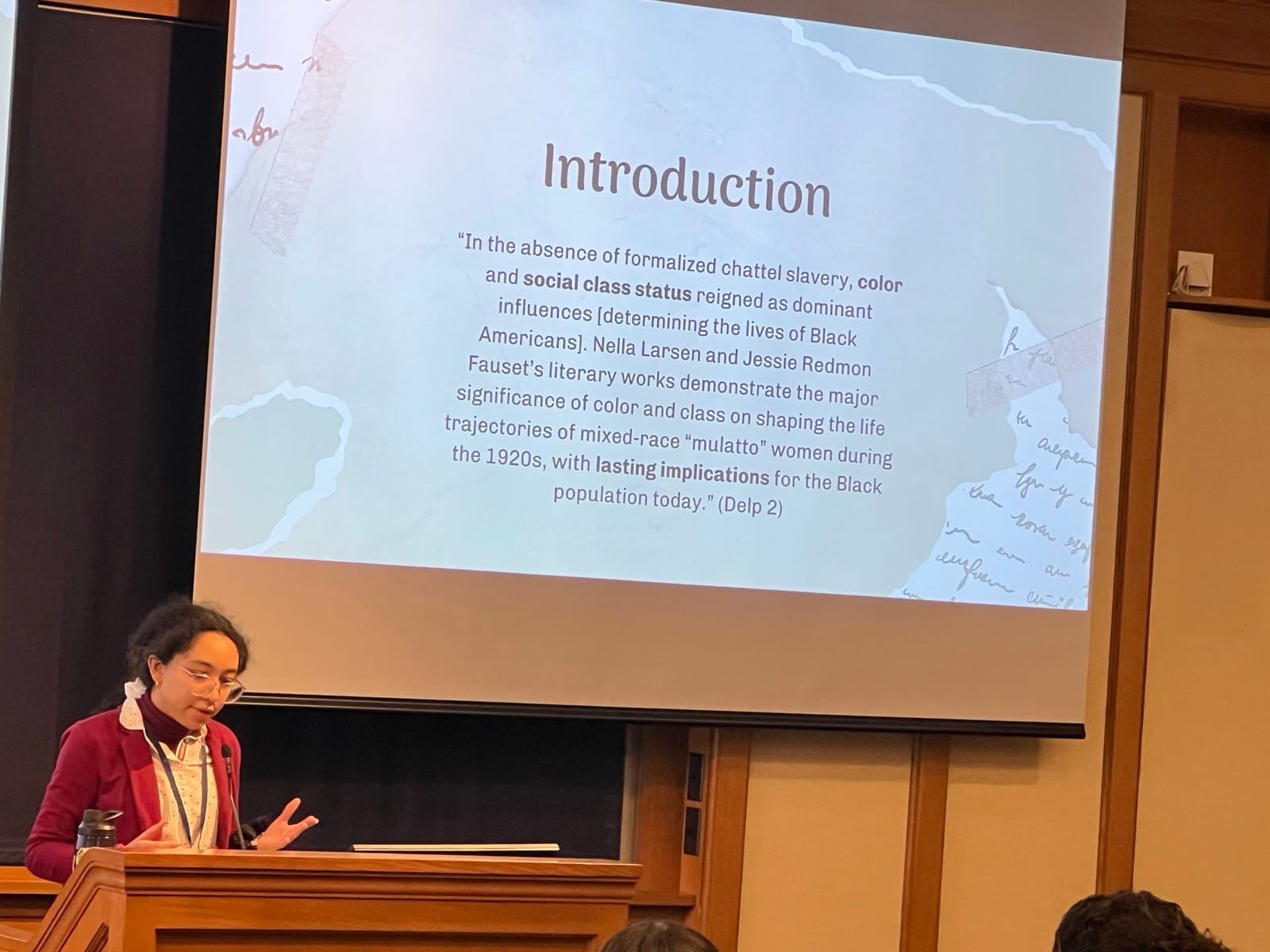
Their thesis, “The Afterlives of the Tragic Mulatto,” examines how a 19th‑century literary archetype — the “tragic mulatto” — emerges from specific historical conditions and continues to shape representations of mixed‑race Black women over time. As Willow described it, the project both “[establishes] this trope” and traces how its meanings persist, asking how literature has reflected — and sometimes shaped — broader social realities. Bringing together literary analysis and historical context, Willow studies how this figure has been constructed through intertwined ideas of race, skin color, and class, and how those constructions evolve across different periods and authors. Their thesis ultimately explores how past narratives continue to inform present understandings of identity, power, and belonging.
Part of their thesis included Nella Larsen’s work, which in particular stayed with Willow over time. “I read ‘Passing’ … in high school … and that was a very intriguing book to me,” they recalled. “That work definitely influenced me … it was always in the back of my mind, probably subconsciously” — part of what pushed them “to take literature more seriously” and ultimately return to it with greater depth in their own scholarship.
That trajectory was further shaped in the classroom at Amherst. “In Caribbean Literature in the Age of Globalization” with Professor of Black Studies Carol Bailey — where they encountered Larsen’s work again — Willow refined their approach to reading literature not just as text, but as a way of tracing power and identity across time, questions that would come to anchor their thesis.
Across all of it, everything that Willow does — the advocacy, the writing, the research — returns to the same fundamental question: Who gets to be seen, named, and taken seriously, and how can we do better?
To Blooming
As graduation approaches, Willow is beginning to look ahead — not leaving Amherst behind, but carrying its questions with them. This fall, they will begin a master’s program in English studies at the University of Cambridge, with the goal of eventually becoming “an English professor teaching also in interrelated disciplines such as gender studies, postcolonial studies, Black studies.”
It’s easy to imagine them in that role. I would take any one of their classes. But wherever they go next, Willow will continue doing what they’ve always done best: caring deeply, asking hard questions, and making space for others to do the same.
While interviewing Willow, they said perhaps the most poetic thing I have ever heard — and it’s something you deserve to hear, too. As we talked about “Anti‑Ableist Amherst” and what they ultimately hoped their writing and advocacy might accomplish, Willow paused, then explained it like this: “You plant the seed [but] don’t see the flower that day. You just have to plant the seed and trust that [it] will grow into the flower. And I’m at [the] very least trying to plant seeds,” they said. “I don’t think Amherst is going to go zero to 200 in a day, but hopefully I can just nudge it along. And if I can nudge it along a little bit, if I can put some good into the world, I will be happy.”
That, more than anything, captures who Willow Delp is and how they have moved through Amherst. They planted seeds. Some have already taken root. Others will bloom long after they’ve gone.
Comments ()