

‘you made me / skin on linen’ Should PISS You Off
Managing Videos Editor Jackson Hersom ’27 reviews Canadian hardcore band PISS’s debut album, exploring its theme of grappling with sexual violence. He connects these emotions to a broader conversation about rape culture and “victimhood.”
It’s rare that you leave an album feeling like a different person than when you pressed play.
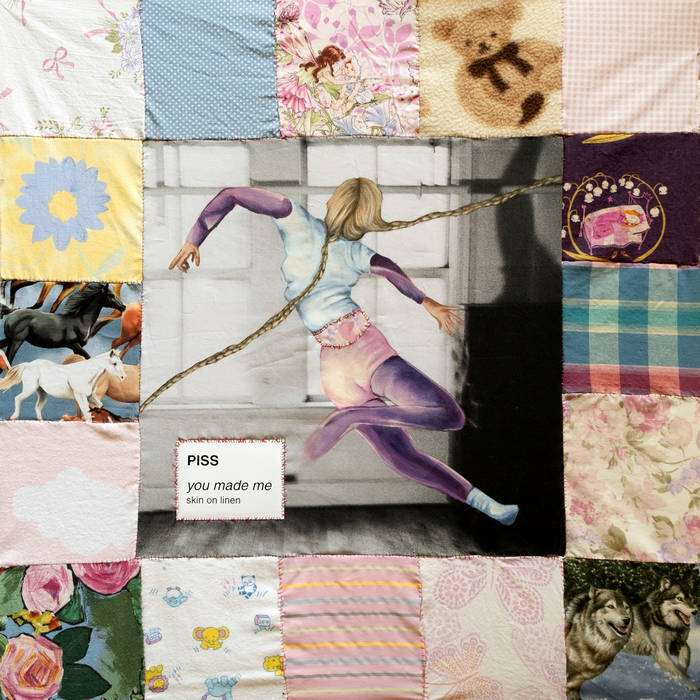
Canadian hardcore band PISS released its searing debut “you made me / skin on linen” on Oct. 30. The group rose to prominence in the Vancouver DIY scene through its haunting live performances, featuring lead singer Taylor Zantingh’s recounting of sexual violence and the survival, suffering, and healing afterward. Blistering guitars, exploding blast beats, and shrieks color reflections on the victimization of women in society and Zantingh’s own corruption of innocence. In its concerts and throughout the album, clips from interviews and lectures by feminist and anti-patriarchal ideologues such as Andrea Dworkin, Toni Morrison, Manon Garcia, Vikki Reynolds, and members of the German feminist militant group Rote Zora are scattered throughout, situating the songs within broader discussions of rape culture, patriarchy, and the utility of violent resistance in self-defense.
However, PISS is not dedicated to supporting one ideology regarding gender-based violence or, in its own words, resorting to “dogmatism.” Likewise, Zantingh doesn’t position her story as definitive in the experience of sexual violence, and she includes the story of feminist icon Gisèle Pelicot alongside her own. The intentionality behind PISS’s narrative and political construction results in a project that is relatable to a wide range of victims from various ideological, experiential, and gender backgrounds.
The result is a harrowing 30-minute record that sees Zantingh announcing herself and her band as one of the most important rising acts of the decade.
“I don’t know if writing about violence is helping me. Am I helping you? I keep trying to make my pain mean something.”
As a musician and writer myself, the album immediately made me jealous. Why couldn’t I find the words to write something like this? How can something so distant encapsulate my own feelings and story so perfectly?
But that is the beauty of Zantingh’s performance: She describes the helplessness of not knowing what to do with one’s story after being violated, a state recognizable to many. For creatives, it is the act of telling their story that makes the pain more bearable. For performers like Zantingh and myself, it is the act of forcing an audience to listen that serves as a form of empowerment.
Zantingh, herself a literary teacher and writer, perfectly encapsulates the thanklessness of the task in “i wanted to be a singer”: “I spent my life learning the right way to scream / So people would listen.”
In the state of victimhood, using one’s voice to tell one’s story is foreboding and potentially dangerous. As a man, you are likely to feel that your pain will be trivialized and even laughed at under the guise that refusing sex, or being raped, is inherently emasculating. As a woman or gender-nonconforming person, you are equally likely to find that family, friends, and society will deny your story out of disbelief. As I’ve entered male-dominated spaces on Amherst College’s campus, the often locker-room-talkish and desperately bro-ey environments feel directly dismissive of, and potentially hostile to, a victim narrative. Even in some creative spaces I’ve engaged in, rape jokes or objectifying statements seem normalized. As stories emerge from similar spaces on other college campuses, such as Cornell University, they validate the suspicion that danger exists not far out of sight. In broader life, becoming known as a victim is a deeply embarrassing and disempowering process, in which your voice will be perceived as nothing but pitiful.
In response, music can be the most powerful tool. When you feel silenced or overlooked, singing, screaming, or even reading words can force those same hostile environments to listen. While it is shameful that only a certain crowd will take one’s stories and voice seriously once translated into music, only upon finding the “right way to scream,” it certainly feels good to see people finally shut up and listen.
“How can we live with men? … There is an arithmetic problem. It can’t be the case that all our friends got violated, and none of our male friends violated anyone.” — Manon Garcia
I recognized the narrative arc of the album as a grieving process after sexual violence. Following acceptance, anger and even hatred toward not just an individual but an entire group of people can be all-consuming. The feeling is as ugly as the music portrays it — speaker-blowing downtuned guitars fit just right. At first, there’s a sense of absolutism toward the violator, a necessity to be distrustful toward anyone and anything that could cause harm again.
This anger is evident in the music itself. Between lyrics, the rest of the band backs out to let Taylor release agonizing screams. In live performances, she throws herself across the stage as she vocalizes, as if the emotions are physically leaving her body. At moments, the rawness of her voice becomes an act of resistance, challenging the forces that seek to sexualize and victimize women. Following an excerpt of Andrea Dworkin’s argument that pornography and rape culture prime women to believe they “like it” and “ask for more” sexual violence, Zantingh embodies this statement in “time loop at hot slit” by slowly transforming shrieks of terror into moans of pleasure. The result is a grotesque listening experience, not one that aims to shock by sonically reproducing sexual violence, but instead provides a vocal embodiment of the issues of discussion.
However, just as a victim moves through their anger and changes perspective, the album does so too. PISS creates a conversation between the featured women’s voices, from Andrea Dworkin’s proposition that violence is the only viable response to rape culture when the law continually upholds it, to Vikki Reynold’s seemingly opposite, pacifist opinion:
“Our boys are being raised in a rape culture and then we’re individually holding them responsible as if they invented misogyny … If we don’t serve this young man who’s willing to talk to us … then he is going to suffer. All our suffering is connected, as is all our liberation.”
It is the experience of going back and forth through these takes, from being actively volatile to forgivingly embracing, that defines the process of losing innocence. In one moment, men seem impossible to ever trust again, and in another, you’re sharing jokes with friends on the football team. Is forgiveness possible? Can you ever learn to trust? You never find an answer, and neither does PISS give us one.
The climax of the album is in “blocking a scene you can’t remember,” where Taylor constantly interrupts and repeats herself during a description of her rape story. In Title IX proceedings, legal processes, or therapy, the victim is constantly asked to mull over the moment of their violation with granular detail. Personally, as with many other victims, the mental pain of recounting my experience with exact language — carrying Taylor’s feeling that “I can do better” — makes the effort of moving forward with accusations or legal action impossible. Again, the song aims to reflect the dissonance and frustration of this process, exploding into the most emotionally resonant and sonically dark point in the album. If you want more listenable or pretty music, PISS argues, then stop promoting a culture that forces performers to resort to such ugly noise.
But PISS brings back meaning to the noise. This is what abrasiveness was meant for — not for the teenage show-off riffing of late ’90s nu-metal, not for the testosterone fests of jean-jacketed moshpits — but for the communication of pain and struggle to those who deeply relate and also those who could never imagine such suffering. It distances as much as it invites in, encouraging us to rage with the band while refusing enough respectability to prevent its appropriation by TikTok algorithms and the mainstream. It denies the cliché while critiquing what’s considered ‘cliché’ for a survivor story. Punk is not dead; it has been waiting for us here.
“Resistance is possible.”
Our stories are not currency. Those of us willing to tell them don’t do so to emphasize a point or to add intrigue to our art. In an age of an increasing ubiquity of rape stories, art seems more useful than ever as a tool of sharing rage and turning experiences of victimization into sources of community and solidarity.
PISS is not trying to be didactic. There is no lesson or point to be extracted from the music. Rather, they create a meeting space for collective anger and conversation on how to channel our experiences into action. If you leave the solemn closing track “i keep trying to change the ending,” without feeling the invisible tug to get up and do something, you haven’t been listening closely enough.
At many points in my time as a songwriter or as a creative leader in bands, acapella groups, and film projects, I ask myself: “Is this really the time or place to tell my story? Am I being overkill, performative, or overreliant on ‘buzzwords’ when I center my opposition to toxic masculinity in the creative spaces I engage in?” It’s easy to feel inauthentic when performing a song describing my experience with rape in front of a dancing crowd of frat bros, just as easy as it is to retreat when a male-dominated music group scoffs at your attempt to question its masculinity.
But “you made me / skin on linen” provides a simple answer: You can never be angry enough. You can never do enough. And at the very moment you’re convinced you’ve escaped the oppressive net of victimhood, especially from the vantage point of a male victim, you become trapped all over again.
The state of victimhood is one without resolution. None receive the closure they hope for. Constant reminders of your status will color your adult life, as the perpetrators live freely and are allowed to move on, while you, the remnant, are stuck in a single moment in time. PISS likewise refuses you the big and bombastic ending, opting for a whisper of distant guitars and a hollowed voice. The listener is left stranded, like the victim, in the bleak state of irresolution.
But even in the darkness,
“I learned some people only believe you when your knees are bleeding … when you’re screaming.”
There’s a light to be found:
“I won’t bleed forever … Soft hands, singing.”
“you made me / skin on linen” is available on PISS’s website and all streaming platforms.


Comments ()